
The Nature of Paint
Doctoral thesis in words & images

The following paintings represent one of the outcomes of my PhD research on natural art materials. For the creative component, which aims to represent the heavy research as a unique 'visual outcome', I adapted paint recipes that I found in the historic archives and created artworks that highlight each ingredient by using that very same ingredient.
With each artwork was an accompanying apothecary glass jar containing a sample of the ingredient.
For the PhD I created one hundred of these for the exhibition.
However due to Covid restrictions, the show never opened to the public. Here is a sampling of the works.
The paintings are an example of an ongoing project to be more sustainable in the twenty-first century art studio, to learn more about the ingredients we use, what secrets nature has to offer, with the aim to foster an ethos that aligns with global eco-trends in other industries.
strict copyright on the text and images

Almond [sold]
[Almond tree gum, nut charcoal, tree bark ink, saffron, white and green earth, magenta and rose petal ink, lavender oil, walnut shell ink on traditional gesso on 640gsm archival paper]
For centuries the gum of the almond tree was used as a binding medium in tempera recipes. It is not as strong as some of the other tree gums but it is very clear and a good alternative if the almond was the only blossom tree weeping the gum, found in the garden or local area.
-
A4 | Eco Certified Archival Paper made in Italy

Beetle [sold]
[Shellac, denatured alcohol, cochineal, vermillion, genuine peat earth, oak gall ink on traditional gesso on 640gsm archival paper]
Shellac is the harvested sticky substance deposited on tree bark by the Lac beetle as she makes her way along the tree. While shellac pops up in a few 20th century tempera recipes it is not as common, perhaps because it yellows with age or that it was often thought to be from the wings of the beetles and therefore an act of cruelty to use. Beetles are just as important as bees and butterflies in the nature of diversity, I look forward to painting more of these fascinating creatures.
-
A4 | Eco Certified Archival Paper made in Italy

Bloodwood [sold]
[West Australian Bloodwood resin and charcoal, West Australian ochres, eucalyptus leaf ink, tree bark ink, green earth, eucalyptus gall ink on traditional gesso on 640gsm archival paper]
As an outcome of the research I was given samples of the Bloodwood resin and ochres that are used by the Indigenous community of Warmun painters in Western Australia. This was a highlight of the PhD journey, not only to have the connection but the ochres are the most beautiful of all.
-
A4 | Eco Certified Archival Paper made in Italy

Cow Urine [sold]
[Dried mango ink, clove oil, Australian ochres, 24k gold leaf, Indian ink on traditional gesso on 640gsm archival paper]
The urine of cows (and humans) is found as an ingredient in many a paint recipe, however from the 1900s synthetic ammonia replaced it. There was, intriguingly, a bright pigment called Indian Yellow which was introduced into the European palette of renowned painters in the late 1700s. It took a century to discover its true source - the urine of Indian cows fed exclusively on mango leaves.
-
A4 | Eco Certified Archival Paper made in Italy
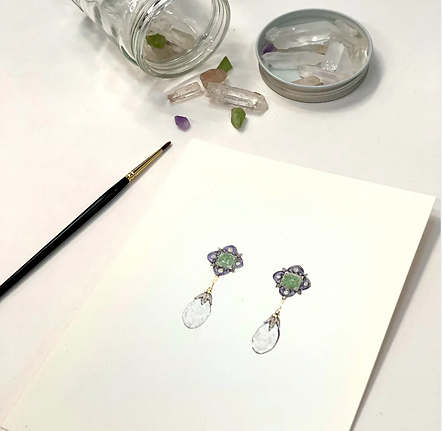
Human [sold]
[Ear wax (cerumen), ground crystals (amethyst, peridot, quartz, topaz), fresh-water pearl, opal, 24k gold, Australian ochres, green earth, pine ink on traditional gesso on 640gsm archival paper]
Human earwax, which has lubricating and anti-bacterial properties, was added to paint mediums to pop the bubbles that formed when mixing. From the 1500s to the 1800s, It was used for miniature painting on ivory along with ground up semi-precious stones, crystals and gold leaf.
-
A4 | Eco Certified Archival Paper made in Italy

Pine [sold]
[Natural tree turpentine, pine resin, Norfolk pine tree resin, tree bark ink, banksia charcoal, green earth, Australian red ochre, pine ink on traditional gesso on 640gsm archival paper]
Pine resin has anti-bacterial properties and was used for wound healing and by artists to make varnishes. The resin was also distilled to make a clear liquid (turpentine) used for thinning paints but could likewise be made from the steaming of pine bark to make wood turps.
-
A4 | Eco Certified Archival Paper made in Italy